Business Transformation Consulting: Grow Your UK Firm
Growth often exposes problems that a smaller business could once work around.
A manufacturer in Derby adds new customers but still relies on spreadsheets to track production changes. A logistics firm in Leicester takes on more contracts, yet jobs still move between inboxes, paper notes, and disconnected systems. Finance chases one set of numbers, operations keeps another, and directors spend too much time asking whose version is right. The business is busy, but it doesn't feel in control.
That's usually the moment business transformation consulting stops sounding like a buzzword and starts sounding necessary. Not because the company wants a glossy strategy document, but because growth has hit a practical limit. People are compensating for poor process design. Managers are making decisions with delayed information. Technology is holding the business together, but it isn't helping it move forward.
Is Your Business Ready for What Comes Next
In the East Midlands, this point emerges subtly. It rarely starts with a dramatic failure. More often, a good business finds that its old way of working no longer fits the scale, speed, or risk of where it is now.
A food distributor might have strong demand but poor visibility across stock, delivery changes, and customer communications. A professional services firm may have adopted Microsoft 365 but still run approvals and reporting manually. A growing charity may have cloud tools in place, yet staff still duplicate data because systems don't speak to each other properly.

The growth wall most firms recognise
The symptoms are familiar:
- Manual rework everywhere: Teams key the same information into multiple systems.
- Slow decisions: Managers wait for reports that should already exist.
- Patchwork systems: Finance, operations, sales, and service use tools that were never designed to work together.
- Fragile knowledge: Critical steps live in one employee's inbox or memory.
- Change fatigue: Staff have seen “improvement projects” before and assume this one will create more disruption than value.
None of that means the business is failing. It usually means the business has outgrown its operating model.
That's the point where a proper transformation approach matters. Not a rushed software purchase. Not a slide deck full of vague ambition. The work is to decide what must change, what must stay stable, and how to improve the business without damaging the parts that already work.
Practical rule: If your people are spending their time compensating for broken process, you don't have a staffing problem first. You have a design problem.
Why disciplined execution matters
The potential for unrealised value in business transformation is often underestimated by boards. Research reported by Consultancy.uk on Sullivan & Stanley's findings states that the average transformation leaves 27% of its promised value unrealised, equal to £27 million for every £100 million invested. That's a useful warning for firms of any size. Value isn't lost only in large enterprise programmes. It's lost when scope drifts, ownership is weak, adoption is poor, and benefits aren't tracked properly.
For mid-sized East Midlands firms, the practical lesson is simple. Transformation has to be run as a value programme, not an IT activity. The right work starts with operational pain points, measurable outcomes, and a realistic understanding of how people will respond to change.
Understanding Business Transformation and Its Drivers
Business transformation consulting is often explained badly. People talk about innovation, disruption, or future readiness, but that language doesn't help a managing director who needs the warehouse, finance team, and customer service desk to work better on Monday morning.
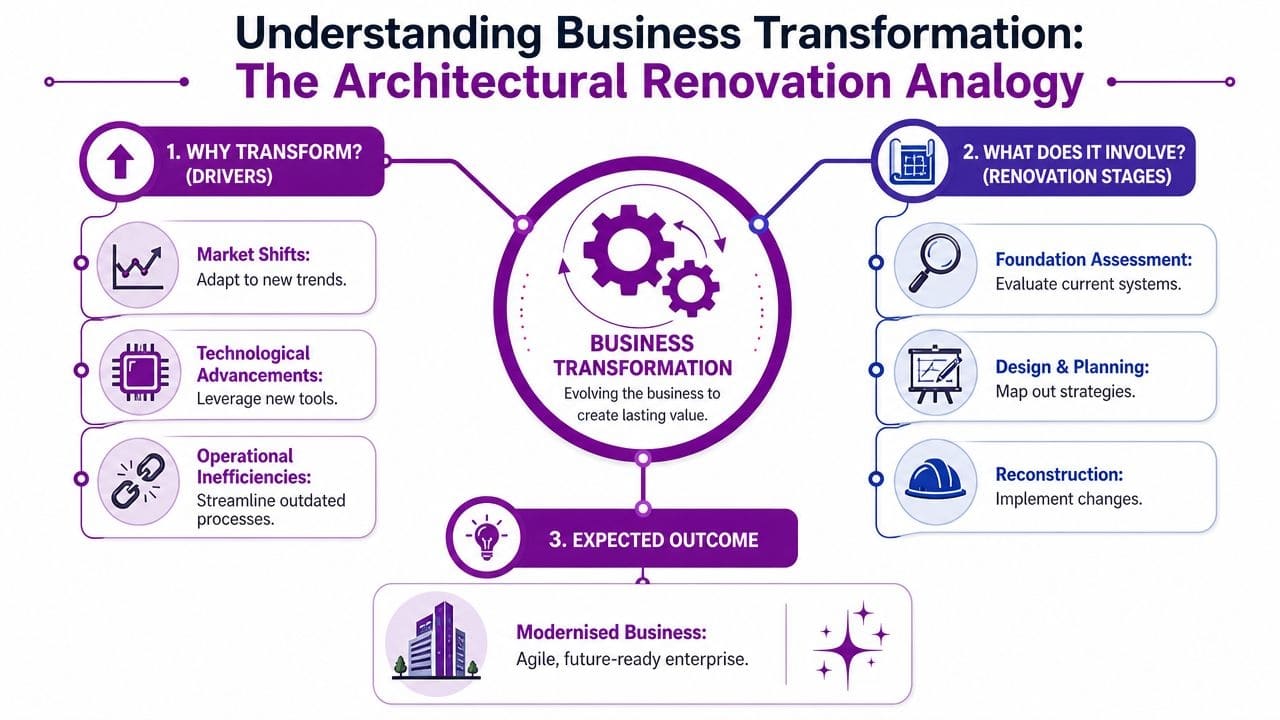
A better comparison is a major building renovation. You're not repainting one room. You're checking the foundations, redesigning how the space works, replacing unsafe or outdated elements, and making sure the finished building supports how people use it.
It's never just a technology project
When a firm says it wants transformation, the work usually sits across four connected areas:
- Strategy: What the business is trying to become, protect, or improve.
- Process: How work should flow from request to outcome.
- People: Who owns decisions, who needs training, and how behaviours change.
- Technology: Which tools support the model, integrate data, and reduce friction.
If one of those is ignored, the programme becomes unstable. New systems won't fix poor handovers. Better dashboards won't help if the underlying data is inconsistent. A strong process redesign won't stick if managers don't reinforce it.
That's why many firms benefit from grounding their thinking in a proper digital transformation strategy for UK organisations before they commit to a toolset or implementation plan.
What's forcing change now
In the East Midlands, the pressure usually comes from a mix of operational and commercial realities rather than fashion.
Some firms need faster quoting, order handling, and reporting because customers expect digital service as standard. Others are dealing with hybrid teams, acquisitions, margin pressure, or legacy line-of-business systems that can't support the next stage of growth. In regulated or data-heavy environments, resilience is also a major driver.
One issue now sits much closer to the centre of transformation than it did a few years ago. Security.
The UK Government's Cyber Security Breaches Survey 2025 found that 43% of businesses experienced a cyber breach or attack in the previous 12 months. That changes the shape of business transformation consulting. A cloud move, workflow redesign, or data integration project can't treat security as a later technical tidy-up. It has to be part of the operating model from the start.
Faster change without stronger controls often creates a more fragile business, not a better one.
The practical meaning of transformation
A sound transformation programme usually does three things at once:
AreaWhat changes in practiceOperating modelDecisions, ownership, approvals, and reporting lines become clearerCore workflowsManual steps, duplicate entry, and avoidable delays are removedPlatform foundationMicrosoft 365, Azure, Dynamics 365, and Power Platform are configured to support the redesigned way of working
The aim isn't to modernise for its own sake. It's to remove the friction that keeps good businesses from scaling cleanly, serving customers consistently, and managing risk properly.
The Four Phases of a Successful Transformation
Most failed transformation work doesn't collapse because the idea was wrong. It stalls because too much is attempted at once, ownership becomes blurred, and people lose sight of what success looks like.
A reliable programme has shape. It moves in phases, each with a clear purpose and a specific output that the business can test, challenge, and approve.
Phase 1 Assess and strategise
This phase is about facts, not assumptions. The team looks at how work currently happens, where delays and rework appear, which systems are involved, and where accountability is weak.
That means workshops with department leads, process mapping, system reviews, and a realistic view of constraints. For a mid-sized East Midlands business, that might include how customer data moves between Outlook, Excel, a finance package, and a CRM, or how approval bottlenecks affect delivery lead times.
Typical outputs include:
- Current-state assessment: A documented view of process, systems, pain points, and risks.
- Priority problem list: The few issues that matter most commercially or operationally.
- Transformation objectives: Clear statements tied to outcomes, not slogans.
A weak phase 1 usually sounds ambitious but vague. A strong phase 1 names the actual problems in plain language.
Phase 2 Design and plan
Once the business knows what must change, the next step is to design the future state. At this stage, many organisations are tempted to rush. They choose software before agreeing process. They approve a budget before defining scope. They assume teams will “work it out” during delivery.
That approach nearly always creates unnecessary cost and resistance.
A better plan covers the following:
-
Future-state workflow design
The business decides how work should move, where approvals belong, and which activities should be automated or simplified.
-
Platform and integration choices
When considering Microsoft 365, Azure, Dynamics 365, or Power Platform, decisions should be tied to business need, not preference.
-
Governance and sequencing
The team decides what happens first, what can wait, and who signs off key milestones.
-
Benefits model
Before implementation starts, the business agrees how value will be measured.
This is also the point where change impact needs honest treatment. If a new process shifts responsibility from one team to another, people need clarity before rollout, not after it.
A short explainer on the delivery journey is useful at this point:
Phase 3 Implement and execute
This is the visible part of transformation. Systems are configured, data is migrated, workflows are built, reporting is set up, and users start working in a different way.
It's also where many projects become too technical. Businesses focus on configuration and forget the habits required to make the change stick.
On the ground: If managers still accept the old workaround, staff will keep using it.
A sound implementation phase includes:
- Technical delivery: Build, configuration, integration, testing, and security controls.
- Change management: Communications, training, role clarity, and local champions.
- Adoption support: Hypercare, floorwalking, service desk support, and issue triage.
- Decision discipline: Fast escalation when scope, data, or process conflicts appear.
Phase 4 Optimise and sustain
Go-live isn't the finish line. It's where the business starts proving whether the transformation is working.
In this phase, leaders review adoption patterns, identify process bottlenecks that remain, refine dashboards, and challenge whether the intended outcomes are appearing in the numbers and in day-to-day operations. Sometimes a workflow needs adjustment. Sometimes a team needs refresher training. Sometimes the original target was wrong and needs to be reset against reality.
Common deliverables here include a benefits review, an optimisation backlog, updated governance, and a plan for continuous improvement. The strongest programmes treat optimisation as part of the design, not as optional clean-up after the budget has been spent.
Your Microsoft Toolkit for Modernisation
A lot of transformation programmes become vague the moment the conversation turns to technology. Mid-sized East Midlands firms do not need vague. They need a stack that solves real operating problems without creating a bigger support burden six months later.
Microsoft gives you that option, if you use it with discipline. I have seen manufacturers around Leicester tidy up document control and shop floor reporting with Microsoft 365 and Power Platform. I have seen service businesses in Nottingham move ageing infrastructure into Azure, then realise the main win was better resilience, cleaner integrations, and fewer firefights for internal IT. The tools matter, but the fit matters more.
Match the tool to the problem
Start with the point of friction in the business, then choose the platform that deals with it.
Business ProblemPrimary Microsoft SolutionTeams rely on email chains and scattered files for collaborationMicrosoft 365Legacy systems need a secure cloud foundation and better resilienceAzureSales, service, and operations hold inconsistent customer or operational dataDynamics 365Repetitive admin work slows staff downPower AutomateReporting is delayed and inconsistent across departmentsPower BIStaff need simple apps without full custom software projectsPower AppsKnowledge workers need help drafting, summarising, and finding informationMicrosoft Copilot
Cloud work needs structure as well as technical skill. A structured Azure Cloud Adoption Framework approach helps firms avoid the common mistake of moving old complexity into a new hosting environment.
What each platform does well
Microsoft 365 gives staff a shared working environment for email, files, meetings, chat, and document management. For many businesses, the key gain is consistency. Teams, SharePoint, and OneDrive can replace local file sprawl, version confusion, and the habit of keeping key process knowledge in individual inboxes.
Azure supports infrastructure modernisation, integration, data services, identity, security, backup, and application hosting. That makes it a good fit for businesses with ageing servers, patchy disaster recovery, or systems that need to exchange data reliably. Azure is not automatically cheaper than on-premise. It is often better governed, easier to scale, and less exposed to single points of failure when designed properly.
Dynamics 365 earns its place when the business is struggling with fragmented operational data. If customer records sit in one tool, service history in another, and finance is relying on exports to work out what is going on, there is a coordination problem, not just a software problem. Dynamics 365 can bring those records into one operational model, but only if the business agrees common definitions and ownership.
Power Platform often delivers the quickest visible wins. Power Automate can remove manual handoffs and approval chasing. Power Apps can replace paper forms, spreadsheets, or ageing access databases with something staff will use. Power BI gives managers timely reporting, which is often the difference between spotting a problem early and finding it at month end.
Copilot can save time in drafting, summarising, searching, and routine knowledge work. It also exposes weak information management very quickly. If permissions are messy, documents are duplicated, and naming conventions have never been enforced, Copilot will not fix that. It will surface it.
Common mistakes with the Microsoft stack
The pattern is usually the same. A firm buys licences first, asks process questions later, and then wonders why adoption stalls.
The most common errors are:
- Buying too broadly, too early: The business pays for capability it has not prioritised or prepared to use.
- Automating poor process: Waste moves faster, but it is still waste.
- Skipping governance work: Permissions, retention, ownership, and data quality stay unresolved.
- Treating low-code as uncontrolled development: Useful apps appear quickly, then become hard to support because no one set standards.
- Assuming Copilot is ready on day one: AI value depends on clean content, sensible access controls, and staff who know when to trust the output and when to check it.
For businesses across the East Midlands, the strongest results usually come from choosing a narrow set of business problems and solving those well first. Microsoft 365, Azure, Dynamics 365, Copilot, Power Platform, and security tools can work together as a coherent operating model. They can also become an expensive patchwork if each purchase is made in isolation.
F1Group is one example of a Microsoft-focused provider that supports this kind of work across cloud, workplace, security, data, and business applications. The useful test is not who can list the most products. It is who can connect those products to the way your business runs.
Measuring the Return on Your Transformation
The hardest conversation in any transformation programme usually happens after the excitement has gone. The board asks a fair question. What did we get for the money, time, and disruption?
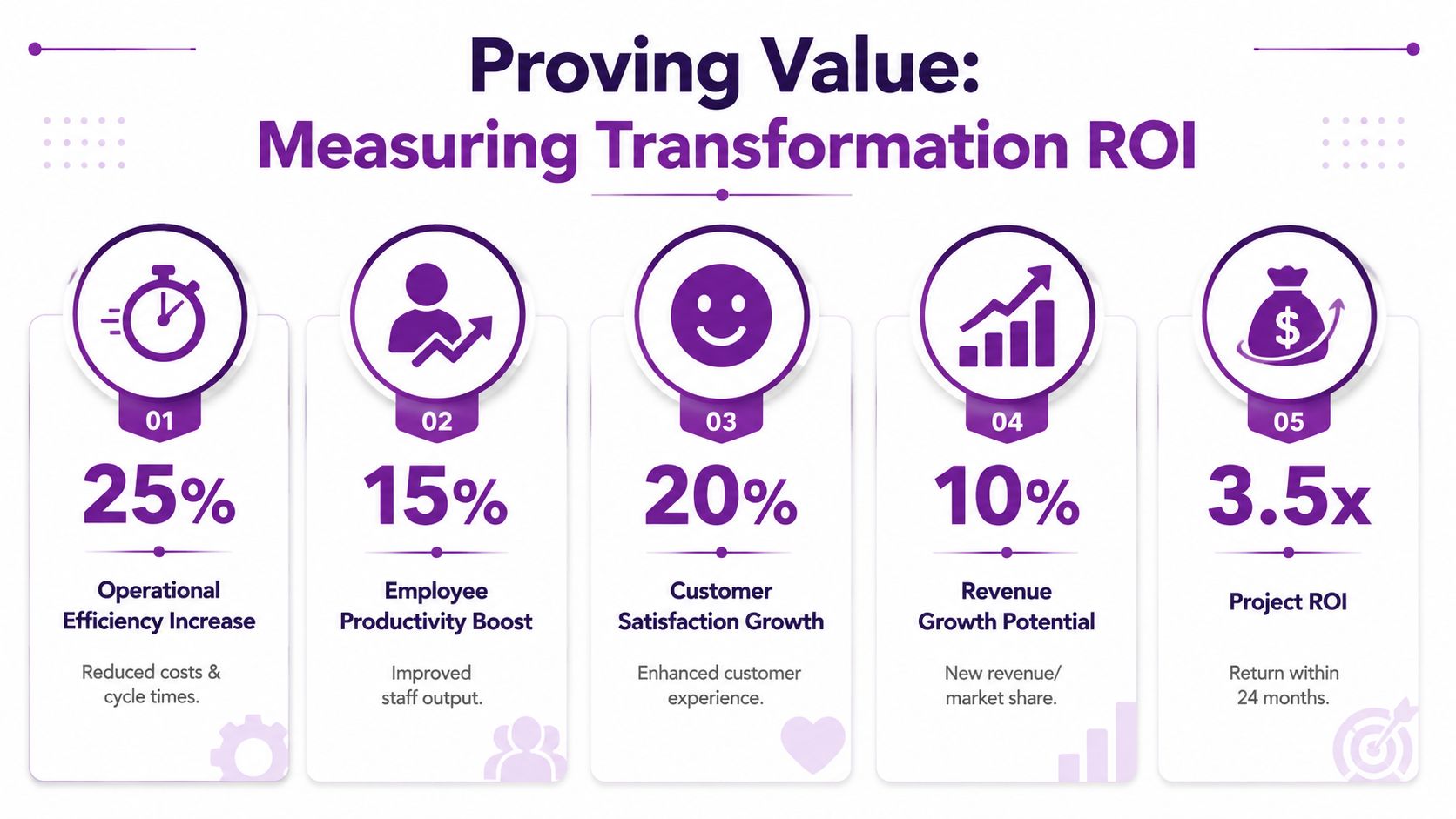
If the answer is “better visibility” or “improved efficiency”, the programme hasn't been managed tightly enough. Value has to be defined before delivery starts, then tracked in a way that finance, operations, and department leaders all recognise as credible.
Start with the baseline, not the promise
McKinsey notes that transformations are most successful when leaders use an objective fact base to identify opportunities and assign top talent to critical initiatives. In practice, that means measuring the current state before anyone starts talking about benefits.
For a mid-sized firm using Microsoft tools, baseline metrics might include:
- Financial measures: Cost to serve, overtime pressure, rework cost, or invoice delay exposure.
- Operational measures: Process cycle time, backlog volume, exception handling, or approval turnaround.
- Customer measures: Response time, complaint themes, fulfilment accuracy, or service consistency.
- Employee measures: Adoption, training completion, process compliance, and support ticket themes.
You don't need dozens of KPIs. You need a short list that reflects where the business expects to create value.
A practical way to build the business case
A workable ROI model usually follows this pattern:
-
Choose one process or value stream
Don't start with the entire business. Start with an area that is painful, visible, and measurable.
-
Quantify the current drag in pounds
Use real payroll cost, contractor spend, delayed billing, or known rework cost where possible. If a precise pound value isn't available, keep the claim qualitative rather than guessing.
-
Define the intervention clearly
For example, replace email approvals with Power Automate, centralise documents in SharePoint, or unify service data inside Dynamics 365.
-
Track after stabilisation
Measure once the new process is being used. Early numbers during disruption are often misleading.
Good ROI discipline isn't about inflating the business case. It's about making weak claims impossible.
Keep examples grounded
A finance director doesn't need fantasy numbers.
https://www.f1group.com/business-transformation-consulting/

