Sungard Availability Services Data Centre
If you're reviewing your infrastructure this year, there's a good chance the name Sungard Availability Services has resurfaced in an awkward way. Perhaps it's on an old contract, on a supplier list, in a disaster recovery runbook, or in the memory of an IT manager who remembers when Sungard was the default name for serious resilience.
That creates a practical problem. A lot of UK organisations still recognise the brand, but far fewer are clear on what its legacy means now, especially when planning cloud migration, colocation, or disaster recovery in the East Midlands.
For anyone searching for a Sungard Availability Services data centre today, the real question is not just what the name used to mean, but what your current infrastructure depends on now. Sungard spent decades shaping how businesses thought about continuity, recovery sites, and enterprise hosting. But history alone doesn't protect your systems. What matters now is whether your current environment is stable, supportable, well documented, and aligned with the way modern businesses run on Microsoft 365, Azure, hybrid infrastructure, and managed services.
For context, it can also help to look beyond the UK market and compare how colocation is framed elsewhere. This guide to colocation in the Philippines offers a useful outside perspective on what businesses typically expect from managed facility space, power, cooling, and connectivity. The geography is different, but the core buying questions are often the same.
Introduction Navigating the Data Centre Landscape
Many businesses in the East Midlands are in one of three positions.
Some still run workloads in a third-party facility and aren't fully certain who owns what after a series of provider changes. Some moved key systems into Microsoft 365 or Azure years ago, but left a few awkward legacy servers behind in colocation. Others want to understand whether the old enterprise model of disaster recovery still makes sense when cloud-native resilience is available.
That uncertainty is normal. Infrastructure decisions tend to stay in place for years, and provider changes often outlast the people who signed the original agreement.
Practical rule: If your disaster recovery plan still names a provider, facility, or contract owner that nobody on your current team has verified recently, treat that as a live operational risk.
The right response isn't panic. It's due diligence.
A sensible review starts with a few grounded questions:
- Who is the current service provider: Not the historic brand, but the legal entity billing and supporting you now.
- What services are still in scope: Colocation, replication, workplace recovery, managed hosting, network connectivity, or only a subset.
- Which systems still depend on that environment: Especially line-of-business applications, file services, identity, and backup chains.
- How quickly you could move if needed: Not in theory, but with realistic dependencies on suppliers, licensing, bandwidth, and internal resource.
For East Midlands organisations, the bigger lesson isn't just about Sungard. It's about avoiding inherited infrastructure assumptions. A resilient estate today often mixes cloud services, identity protection, backup immutability, secure connectivity, and a clear operating model. The provider matters, but the architecture matters more.
Who Were Sungard Availability Services
Sungard Availability Services mattered because they weren't a niche hosting provider. They were one of the names that helped define what enterprise continuity looked like for a generation of IT teams.
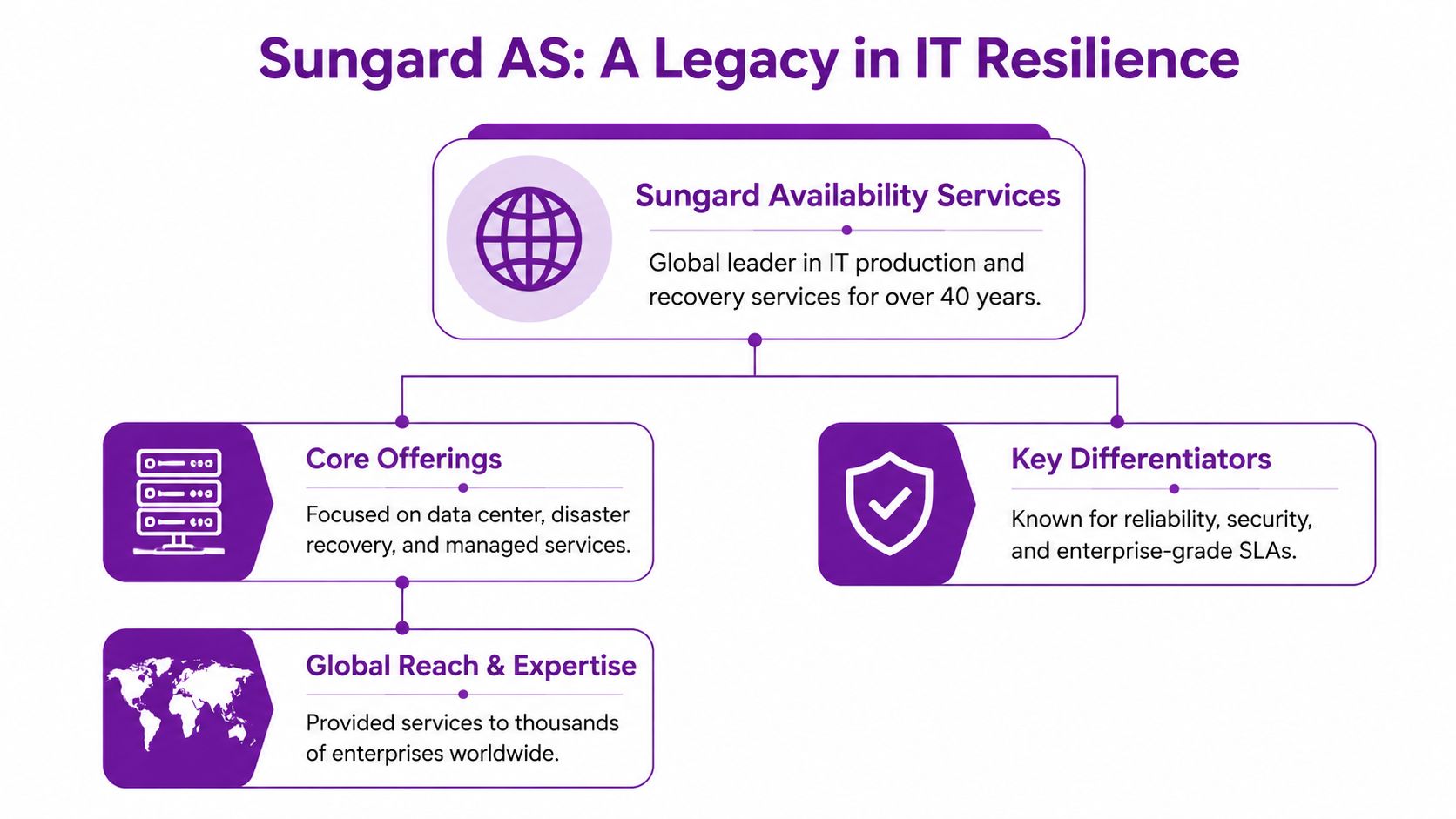
Historically, Sungard AS had over 40 years of experience in IT production and recovery services, managed 75 hardened data centres and workplace recovery facilities, and at its peak operated a global network of 66 data centres. That footprint included 18,000 square feet of UK facility space, with ISO 27001 certification supporting the information security posture enterprises expected from a provider of that size, according to Data Center Catalog's Sungard Availability Services profile.
Why the name carried authority
For years, if a business needed serious disaster recovery, Sungard was often on the shortlist. Not because the market lacked alternatives, but because Sungard had built a reputation around resilience, structured recovery services, and facilities designed for continuity rather than simple server housing.
That distinction matters. A basic hosting site gives you rack space and power. A continuity-led provider builds around failure scenarios, recovery processes, operational discipline, and support for demanding workloads.
Sungard's model appealed most to organisations that couldn't afford improvisation. Think regulated businesses, complex multi-site estates, and firms running older applications that couldn't be lifted neatly into cloud services without redesign.
What made them influential
Their influence came from combining several things that don't always appear together:
- Facility depth: Purpose-built recovery and data centre services rather than generic hosting alone.
- Operational maturity: The processes and support expectations that larger enterprises usually demand.
- Hybrid relevance: A model that could sit between traditional infrastructure and newer cloud approaches.
- Security credibility: Certification and hardened environments that reassured risk-conscious buyers.
Sungard's legacy isn't just that they ran data centres. It's that they helped businesses treat continuity as an operational discipline rather than a box-ticking exercise.
The business was also substantial in commercial terms. Data Center Catalog notes annual revenue of approximately $773 million in 2021 in that same company profile, which helps explain why the later transition was so closely watched by customers and partners alike.
For UK businesses, especially those that inherited older infrastructure decisions, that history explains why the brand still appears in conversations. It also explains why the later uncertainty has been so disruptive. When a long-established continuity provider changes shape, customers don't just lose a supplier name. They lose assumptions they may have built processes around for years.
Core Data Centre and Recovery Services Explained
The easiest way to understand a Sungard Availability Services data centre is to separate the service stack into three practical categories. Each solved a different problem, and businesses often used more than one at the same time.

Colocation
Colocation is the simplest to picture. Your business owns the servers, storage, and often the software stack, but places that equipment in a specialist facility with resilient power, cooling, physical security, and connectivity.
For some organisations, that's still a sensible model. If you rely on hardware-bound systems, specialist appliances, or licensing arrangements that don't translate cleanly to Azure, colocation can buy time and stability.
What doesn't work is treating colocation as a long-term strategy by default. It can become an expensive holding pattern when every hardware refresh, firewall change, and failover test still depends on ageing kit and shrinking in-house expertise.
A good review asks whether your colocation estate is still a deliberate design choice or the result of inertia.
DRaaS
Disaster Recovery as a Service, or DRaaS, goes further. Instead of just housing your equipment, the provider supports a recovery environment designed to take over when your primary systems fail.
Sungard's DRaaS platform supported workloads including x86, UNIX platforms such as AIX, Solaris, and HP-UX, plus IBM i, with over 1,000 pre-configured server images available across geographically separated recovery locations, as described by Enterprise Storage Forum's Sungard Availability Services overview.
That matters because mid-sized businesses often carry more platform diversity than they realise. A company may have modern Microsoft workloads for email and collaboration, a Windows-based finance system, and one stubborn legacy platform that still runs a core operational process. DRaaS exists for that messy reality.
Field advice: The more mixed your estate is, the more carefully you need to check whether your recovery design covers the odd systems no one wants to touch.
If you're comparing older DRaaS models with current cloud recovery options, it's worth understanding how backup and recovery approaches differ in practice. This article on how to ensure business continuity with cloud backup is a helpful companion read because it highlights the operational side of keeping services restorable, not merely stored.
For a more direct look at planning options, F1Group also has a guide to disaster recovery service that helps frame what good recovery design should include.
A short explainer helps here:
Cloud and hosting
The third layer was managed hosting and cloud-aligned infrastructure. This sat between pure colocation and fully cloud-native services.
Some businesses wanted someone else to run the platform beneath their applications. Others needed a path into hybrid IT without rebuilding everything at once. Sungard's services were built to support that middle ground.
In practical terms, this model works when:
- Your team wants operational support: Patching, monitoring, and infrastructure management need outside help.
- You can't move every workload at once: Legacy dependencies often force a phased approach.
- You need controlled migration: Especially where compliance, downtime windows, or application coupling make rapid migration risky.
It doesn't work well if the end goal is vague. Hosted infrastructure becomes a limbo state when there's no roadmap for modernisation, rationalisation, or retirement of older systems.
Security around the facility
Enterprise customers also expected strong site controls. Enterprise Storage Forum documented physical security features including CCTV, security staff, proximity card readers, and FM-200 fire suppression systems in Sungard facilities.
Those details aren't marketing extras. They signal the difference between a serious operational facility and a basic server room. For businesses handling regulated data, sensitive client records, or critical services, those controls form part of the wider trust model around infrastructure.
The Framework of Trust SLAs Security and Compliance
A data centre provider earns trust long before an outage happens. The true test is whether the service model, contracts, controls, and operating discipline stand up when something goes wrong.
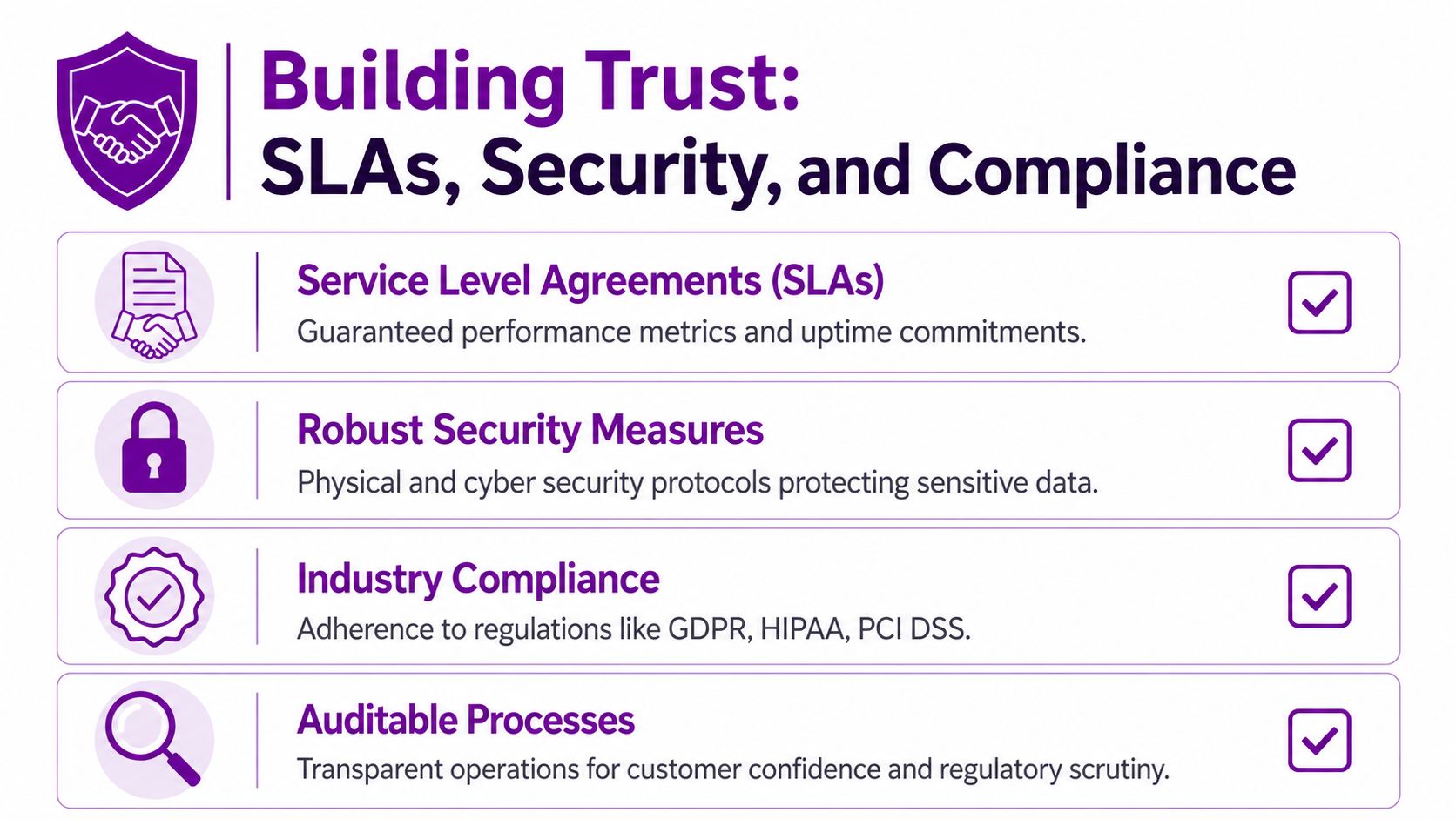
That was one reason enterprise buyers looked closely at SLAs, security controls, and recognised standards. A provider might have a good sales pitch, but if the recovery terms are vague or the responsibilities are blurred, the contract won't help much in a live incident.
What good SLAs actually do
An SLA should answer operational questions, not just legal ones. If a provider talks about availability but can't clearly explain recovery responsibilities, escalation paths, test procedures, support boundaries, and service exclusions, the agreement is weak no matter how polished it looks.
In practice, IT teams should check:
- Recovery definitions: Are recovery objectives tied to specific systems and service tiers?
- Operational ownership: Who handles failover actions, validation, and rollback?
- Testing rights: Can you test the plan properly without commercial friction?
- Support model: Do you get named service management, a shared desk, or best-efforts triage?
Too many organisations discover the gaps only when a serious incident forces everyone to interpret the contract under pressure.
Security and compliance in the UK context
For UK businesses, information security management and evidence of process maturity still matter. In the earlier company profile, Sungard's environments were described as supported by ISO 27001, which remains a recognised benchmark when assessing whether a provider treats information security as a governed discipline rather than an ad hoc technical function.
That said, certification is only one part of the picture. A useful supplier review also asks how controls are run day to day, how access is governed, how incidents are communicated, and what evidence you can inspect.
A practical way to structure that review is to use a recognised assessment method. F1Group's guide to the Cyber Assessment Framework is useful here because it helps organisations turn broad security concerns into specific review areas.
Strong infrastructure partnerships are built on evidence. Not promises, not brand recognition, and not assumptions left over from the last contract renewal.
Hybrid connectivity and integration
Another trust factor is whether the provider fits your actual architecture. By the final phase of its UK relevance, Sungard's colocation services were being enhanced with Megaport cloud connectivity introduced in August and September 2020, enabling integration with public and private cloud services from partners including Dell Technologies, VMware, and Amazon Web Services, as noted in the earlier Data Center Catalog profile.
That kind of connectivity matters because many businesses don't run in one place. They run across Microsoft 365, Azure, branch offices, specialist applications, third-party platforms, and retained on-premise systems. A provider that can't support that reality becomes a bottleneck.
The 2022 Transition and Impact on UK Data Centres
Most of the confusion begins here.
Sungard AS filed for Chapter 11 bankruptcy in April 2022, and its international assets, including those in the UK, were transferred to 11:11 Systems by late 2022. At the same time, the available information leaves uncertainty around the specific operational status and continuity of the former UK data centre facilities, according to Wikipedia's Sungard Availability Services entry.

Why this matters to UK customers
For a former customer, the issue isn't just whether the building stayed open. The bigger issue is whether the commercial and operational model changed in ways that affect risk.
A transition can alter several things at once:
- Support relationships: The people who knew your environment may no longer be involved.
- Contract clarity: Historic service descriptions may no longer map neatly to the current provider structure.
- Escalation routes: Incident handling can become less clear during ownership changes.
- Strategic fit: A provider that acquires assets may not offer the same long-term roadmap you assumed before.
None of that automatically means service quality declined. It does mean customers should stop relying on inherited assumptions.
Questions worth asking now
If your business still has any dependency linked to Sungard's historic footprint, ask direct, document-based questions.
Focus areaWhat to verifyContract ownershipWhich legal entity now provides the service and signs the SLAFacility statusWhether your workloads still sit in the same physical site or a changed estateData handlingHow data location, backups, and access are currently governedSupport continuityWho responds to incidents, who manages service reviews, and how escalation worksExit planningWhat notice periods, migration support, and extraction obligations apply
These are not theoretical checks. They affect budgeting, audit readiness, and recovery planning.
If a provider transition leaves you unable to answer basic operational questions in writing, your first priority is clarity, not optimisation.
The practical lesson
The lasting lesson from the 2022 transition is straightforward. Brand familiarity is not a substitute for current assurance.
A provider may have had an excellent reputation for years and still become the source of uncertainty later. That's why resilient IT strategy has to include supplier review, documented architecture, and a migration path for critical workloads. If your organisation can't move because no one fully understands the dependencies, that's a governance issue as much as a technical one.
For East Midlands firms, especially those with lean internal IT teams, this is often the moment to review whether older hosting arrangements still deserve a place in the estate or whether a move to better-documented, cloud-aligned services would reduce operational risk.
Checklist for Evaluating Your Next IT Infrastructure Partner
When organisations replace or reassess a hosting or recovery provider, they often compare price first. That's understandable, but it usually leads to a poor decision. The right comparison is operational fit first, commercial fit second.
A capable partner should be able to explain how they support your workloads, how they document responsibilities, how they handle migration, and how they help you leave if the relationship no longer fits. If any of that is fuzzy, keep digging.
The service model at managed IT services firm level is relevant here because modern support isn't just about hosting infrastructure.
https://www.f1group.com/sungard-availability-services-data-centre/

