Sage 200 vs Sage 50 A UK Guide for Growing Businesses
The fundamental difference between Sage 50 and Sage 200 is really quite simple. Sage 50 is the go-to accounting software for small UK businesses that need a reliable, no-fuss solution. On the other hand, Sage 200 is a much more powerful system designed for growing, complex businesses that have hit the limits of what basic software can do.
Your choice ultimately comes down to where your company is right now and, just as importantly, where you plan on taking it.
Choosing Your Sage Solution: A Quick Comparison
Picking between Sage 50 and Sage 200 isn't about finding the "best" software, but the right fit for your business's current stage and future ambitions. For startups and smaller, established businesses across the East Midlands, Sage 50 offers a solid and affordable way to manage finances. It handles core accounting, ensures you're compliant with Making Tax Digital (MTD), and is well-known for being easy to get to grips with.
But businesses grow. As they do, they often find themselves bumping up against the ceiling of entry-level software. That's precisely when Sage 200 comes into its own. It’s more than just an accounting package; it’s a full-blown business management solution, what many would call an Enterprise Resource Planning (ERP) system. It’s built for businesses with higher transaction volumes, more employees, and complex operational needs like managing stock across multiple locations or digging into advanced financial data.
The move from Sage 50 to Sage 200 is a classic sign a business is maturing. It's the moment you shift from simply managing daily accounts to strategically directing the entire operation with integrated data.
As you can see, the right path starts with an honest look at your company's scale and complexity.
Sage 50 vs Sage 200 At a Glance
This table provides a quick side-by-side comparison of the fundamental differences between Sage 50 and Sage 200 to help you quickly identify the best fit for your business.
CriterionSage 50Sage 200Target BusinessStartups & small businesses (e.g., up to £5m turnover)Medium-sized businesses (e.g., £2m - £100m turnover)User CapacityUp to 20 users (optimal performance under 10)Up to 200+ users (desktop and web access)Core FunctionalityStandard accounting, invoicing, VAT, basic stockAdvanced financials, BI, CRM, manufacturing, multi-site stockDatabaseProprietary database with transaction limitsMicrosoft SQL Server, handles millions of transactionsCustomisationLimited to standard reports and basic add-onsHighly customisable with dedicated modules and API accessPricing ModelMonthly subscription (approx. £33 - £145/month)Bespoke pricing based on modules and users (starts from £290/month)
While this guide focuses on the Sage family, it’s always wise to know the lay of the land. For a direct comparison with another major player, you might find this guide on QuickBooks vs Sage useful. Understanding the broader market gives you valuable context.
Ultimately, the goal is to choose a Sage product that won't just support your business, but will actively help it thrive.
Phone 0845 855 0000 today or Send us a message
When Sage 50 Is The Right Choice For Your Business
For countless small businesses and start-ups across the UK, Sage 50 has long been the go-to accounting package. It's often the first proper system a new business owner puts in place, providing a reliable, straightforward way to manage finances without the hefty price tag or complexity of a full-blown ERP system.
It’s built for simplicity and effectiveness. If you're a sole trader, a small high street shop, a consultant, or any new venture needing to get your books in order, Sage 50 gives you the essential tools. You can handle daily accounts, send professional invoices, keep a tight grip on cash flow, and stay compliant with UK regulations like Making Tax Digital (MTD) for VAT right from day one.
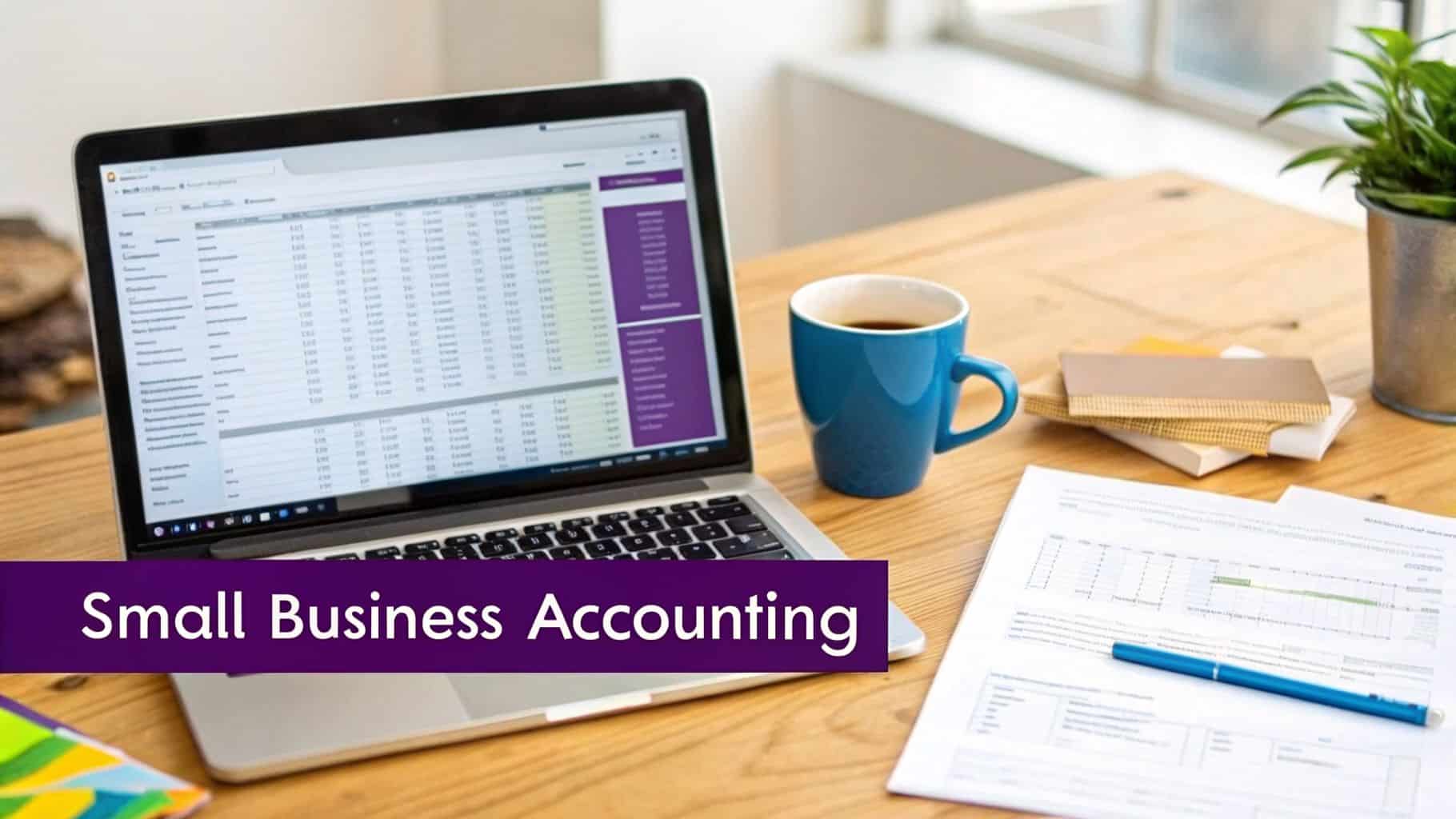
The interface is clean and designed for people who are experts in their trade, not necessarily in accounting. It presents your financial position clearly, helping you make quick, informed decisions without getting lost in menus.
The Ideal Sage 50 User Profile
So, what does the typical Sage 50 user look like? From our experience working with businesses across the East Midlands, it’s usually a company that fits one of these descriptions:
- Start-ups and Sole Traders: You need an affordable, easy-to-use system to manage income, expenses, and tax obligations from the get-go.
- Small Retailers: You're operating from a single location and need solid, basic stock management and maybe a link to your point-of-sale system.
- Consultancies and Service Firms: Your main job is invoicing for your time and expertise, tracking project costs, and chasing payments.
- Businesses with a Small Team: You have a handful of staff who need to access the accounts system, but not all at once.
Sage 50 is designed to handle up to 1.5 million transactions, which is more than enough for most small businesses. While it technically supports up to 20 users, we find it runs best with 10 or fewer people logged in simultaneously. It’s perfect for firms in places like Lincoln or Nottingham just starting out, where the immediate need is straightforward invoicing and VAT management. You can learn more about how Sage 50 compares to its bigger sibling.
Sage 50 is the dependable workhorse for the UK’s small business economy. It provides the essential financial control needed to build a stable foundation, allowing entrepreneurs to focus on growth rather than getting bogged down in complex software.
Recognising The Practical Limits
While Sage 50 is brilliant at what it does, it’s crucial to know its limitations. These aren't flaws; they are deliberate design choices to keep the software accessible and affordable. The system has a hard ceiling on its database size, and performance can really start to lag once you push past that 1.5 million transaction mark or have more than 10 concurrent users.
Stock control is another key area where you’ll find a clear ceiling. It’s great for managing inventory in one place, but it doesn't have the tools for more complex operations. If you need to manage stock across multiple warehouses, use specific bin locations, or apply advanced stock valuation methods, you'll quickly run into a wall.
Let's imagine a small service company in Leicester. They start with two directors using Sage 50, and it’s perfect for sending invoices and filing VAT returns. As they grow, they hire a few staff and start selling a related product from their office. Managing this small amount of stock is simple.
But then they open a second small office in Derby and want to hold stock there too. Suddenly, the first signs of trouble appear. Sage 50 can't natively track stock across two separate locations. The team starts relying on spreadsheets to figure out what's where, which inevitably leads to mistakes and wasted time. This is the classic signal that it's time to consider the next step in the Sage 200 vs Sage 50 discussion.
Phone 0845 855 0000 today or Send us a message.
Why Growing Businesses Upgrade To Sage 200
There comes a point in every growing business’s journey when the software that helped you get started begins to hold you back. If you’re using Sage 50, you know it’s a brilliant tool for smaller operations. But when your complexity starts to outpace its simplicity, it’s time for a strategic change.
Making the leap to Sage 200 isn't just about getting a new piece of software; it's about making a deliberate move to scale your operations, manage more complex processes, and gain the kind of deep operational control you now need. Sage 200 was built for this exact moment. It’s a genuine Enterprise Resource Planning (ERP) solution designed for medium-sized businesses, particularly those in demanding sectors like manufacturing, distribution, and construction.
Handling Increased Scale And Complexity
One of the first things you'll notice with Sage 200 is its sheer horsepower. Where Sage 50 can start to feel the strain with more users or data, Sage 200 is built for a much heavier workload without sacrificing speed or stability. For ambitious businesses across the East Midlands, this is often the primary driver for an upgrade.
It easily supports up to 50 concurrent desktop users (or over 100 web users) and can process a staggering 9 million transactions. This capability is built on the back of its Microsoft SQL database—a world away from Sage 50’s file-based system. This isn't just a technical detail; it means superior data security, reliability, and performance, especially as your transaction volume skyrockets. For a growing wholesaler in Leicester or a manufacturer in Nottingham, this is a non-negotiable foundation for growth.
While the database is a cornerstone, it’s one part of a bigger picture. It's worth seeing how other advanced platforms, like Microsoft Dynamics 365, also leverage powerful platforms to manage business-wide operations.
The upgrade to Sage 200 marks the point where a business stops just recording transactions and starts using data to drive strategic decisions across the entire organisation.
Advanced Tools For Multi-Site Operations
Let’s put this into a real-world context. Imagine a successful distributor based in Newark who has relied on Sage 50 for years. Business is good, so they open a new warehouse in Grimsby to better serve the Lincolnshire coast. Suddenly, Sage 50's limitations create a serious operational bottleneck.
This is precisely the kind of challenge Sage 200 is designed to solve. It introduces advanced inventory management tools that are a game-changer:
- Multi-Site Stock Control: See and manage inventory across all your warehouses, depots, or stores from a single, unified view.
- Bin Locations: Pinpoint the exact location of stock within each warehouse, drastically speeding up picking and stock-taking.
- Batch and Serial Number Traceability: Crucial for any business needing quality control, recall management, or warranty tracking, like food distributors or electronics suppliers.
- Perpetual Inventory: Your stock levels are updated in real-time, giving you an accurate picture without needing to shut down for disruptive, full-site stocktakes.
For our Newark distributor, this means they can instantly see stock levels in both Newark and Grimsby. They can fulfil an order from the most logical location, transfer stock between sites effortlessly, and have complete, real-time visibility over their entire operation—something that's simply out of reach with Sage 50.
On top of this, Sage 200 brings far more sophisticated financial management. Its three-tier nominal ledger (letting you analyse by Code, Cost Centre, and Department) provides a much more granular view of your finances. You can finally analyse the profitability of the Grimsby branch versus the Newark one, or drill down into the performance of specific product lines within each location.
Ultimately, moving to Sage 200 is about giving your business the robust framework it needs to handle the complexities of growth. It provides the capacity, control, and insight required to turn ambition into a sustainable, scalable reality.
Phone 0845 855 0000 today or Send us a message.
A Detailed Comparison Of Core Business Functions
When you're weighing up Sage 200 vs Sage 50, it's easy to get lost in feature lists. The real story, though, isn't just what each system can do, but how it does it. This difference has a massive impact on your day-to-day efficiency and, ultimately, your ability to grow. Moving from Sage 50 to Sage 200 isn't just an upgrade; it's a fundamental shift from straightforward accounting to true business management.
For a smaller business, Sage 50 is often the perfect fit. It’s a rock-solid, dependable tool for managing your finances, handling VAT, and keeping on top of basic inventory. But as your business starts to scale, the very simplicity that made it so effective can begin to feel like a bottleneck.
This is exactly where Sage 200 comes into its own, offering a much deeper and more adaptable way of running your business. Let's look at the practical differences across the functions that matter most.
Financial Management And Reporting
Sage 50 runs on a standard nominal ledger, which is perfectly fine for a small company's financial reporting. It gives you a clear profit and loss and balance sheet, but trying to dig deeper for more detailed analysis can be a real struggle.
Sage 200, on the other hand, is built on a powerful three-tier nominal ledger. This lets you analyse your finances by Nominal Code, Cost Centre, and Department. Suddenly, you get a much more granular view of what's really happening in your business. For instance, a company with offices in both Leicester and Nottingham can easily analyse the profitability of each site independently—something that’s next to impossible in Sage 50 without clunky workarounds.
On top of that, Sage 200 introduces flexible accounting periods. You can keep periods open, close them when you're ready, and even post transactions into future periods. This gives your finance team far more control and flexibility.
Sage 200 turns your finance department from a team that just records history into a strategic partner for the business. Its built-in Business Intelligence (BI) tools allow for deep, custom analysis, turning raw data into the kind of insight that helps you make better decisions.
Stock Management And Control
For many growing businesses, especially in distribution and manufacturing, stock control is the biggest pain point and the main driver for upgrading from Sage 50. The stock management in Sage 50 is really designed for a single location with basic valuation methods.
Sage 200 offers a completely different world of control. A key differentiator in UK deployments is its superior stock management and customisation. This is crucial for East Midlands industries like wholesale, manufacturing, and hospitality, where Sage 50's basic single-location FIFO costing can really hold back growth. Sage 200 changes the game with multi-warehouse support, costing per product group, and full manufacturing modules. It even enables cyclical stock takes, which can dramatically reduce discrepancies. Find out more about Sage 200's advanced capabilities at Paradise Computing.
Think about a multi-site distributor using Sage 200. They can:
- Manage Multiple Warehouses: Track stock levels in real-time across different locations, and even flag stock as available for sale, in quarantine, or returned.
- Implement Batch/Serial Traceability: Follow individual items or batches right from the supplier to the customer, which is vital for quality control and any potential recalls.
- Handle Landed Costs: Correctly assign costs like shipping, duty, and insurance to your stock. This gives you a true, accurate picture of your product profitability.
- Perform Cyclical Stock Takes: Count specific sections of your warehouse without having to shut down your entire operation, ensuring your inventory records stay accurate all the time.
This level of detail is simply not something Sage 50 was built for.
Customisation And Integration
Sage 50 allows for some light customisation, mostly around changing report layouts and using a limited selection of third-party add-ons from the Sage Marketplace. It’s a fairly closed system that’s designed to work well right out of the box.
Sage 200, however, is built from the ground up to be adapted. It has a rich ecosystem of specialist modules for sectors like manufacturing, construction, and retail. More importantly, it features a powerful Application Programming Interface (API). This allows you to create deep integrations with your other essential systems, whether that's a CRM, an e-commerce platform, or a piece of bespoke industry software. This open architecture means Sage 200 can become the central hub for your entire technology setup, perfectly moulded to your unique ways of working.
Ready to explore which Sage solution fits your business? Phone 0845 855 0000 today or Send us a message.
Integrating Sage With Your Microsoft Ecosystem
How well an accounting package talks to your other essential tools can be the deal-breaker. In the Sage 200 vs Sage 50 discussion, the way each system interacts with the Microsoft suite is a world apart. While both offer some connectivity, their underlying philosophies and capabilities are fundamentally different.
Sage 50’s integration is best described as practical. It plays nicely with Microsoft 365, letting you sync your contacts with Outlook or pull figures into Excel. For a small business that just needs to move basic information around without any fuss, this is often perfectly adequate. It gets the job done.
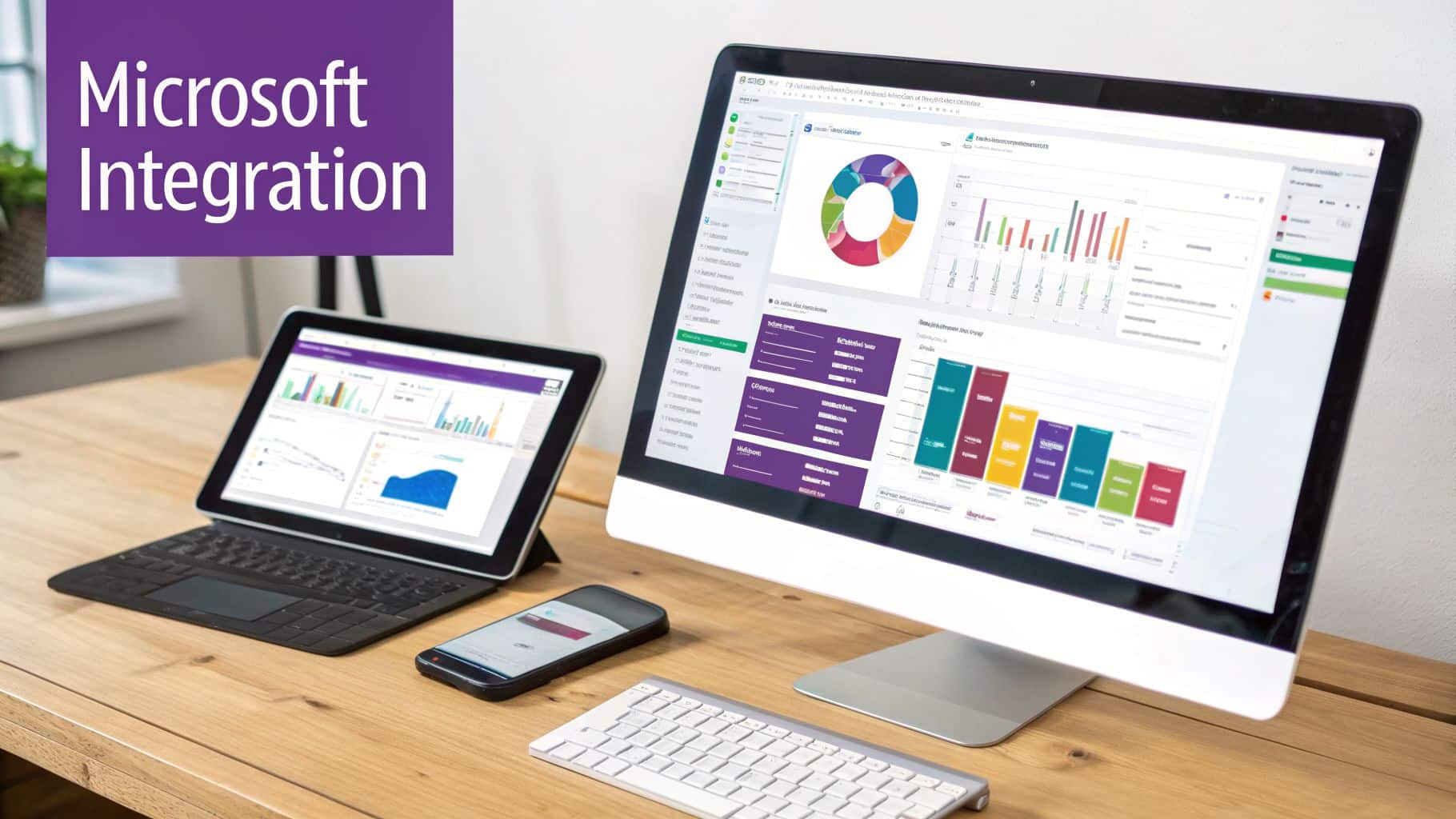
The picture changes, though, as a business grows and starts relying more heavily on the wider Microsoft stack. Once you're using tools like Power BI for serious analysis, Power Apps for custom solutions, and hosting on Azure, you quickly hit the ceiling with Sage 50. It simply wasn't designed for that level of deep, two-way data conversation.
Sage 200: A Natural Partner for the Microsoft Power Platform
This is where Sage 200 really comes into its own. It isn’t just compatible with Microsoft's more advanced tools; it was built from the ground up to be a central part of a bigger business management ecosystem, often hosted on Microsoft Azure. The secret lies in its powerful and open API (Application Programming Interface).
This API unlocks a level of connectivity that goes far beyond the simple data exports of Sage 50.
https://www.f1group.com/sage-200-vs-sage-50/

